

Man Made Rivers: Engineering Solutions to Global Water Scarcity
Water shortages are among the most pressing challenges of our time, particularly in arid regions where natural resources are unevenly distributed. Saad A. Alghariani (1993) argues that large- scale interbasin water transfers, which he terms Man Made Rivers, offer a technically feasible and economically rational response to severe scarcity. Libya’s Great Man Made River project stands as the most ambitious example, providing lessons for other water-stressed regions such as North Africa, the Middle East, and the southwestern United States.
The idea of constructing rivers is not as far-fetched as it sounds. Advances in hydraulic engineering now make it possible not only to control natural rivers but also to build entirely new watercourses. Man Made Rivers extend this principle on a massive scale, transferring water across vast distances from both surface and groundwater sources. Unlike earlier projects confined within national borders, such as California’s State Water Project or Pakistan’s Triple Canal system, modern proposals increasingly envision transboundary transfers, such as Turkey’s Peace Pipeline, to address regional imbalances.
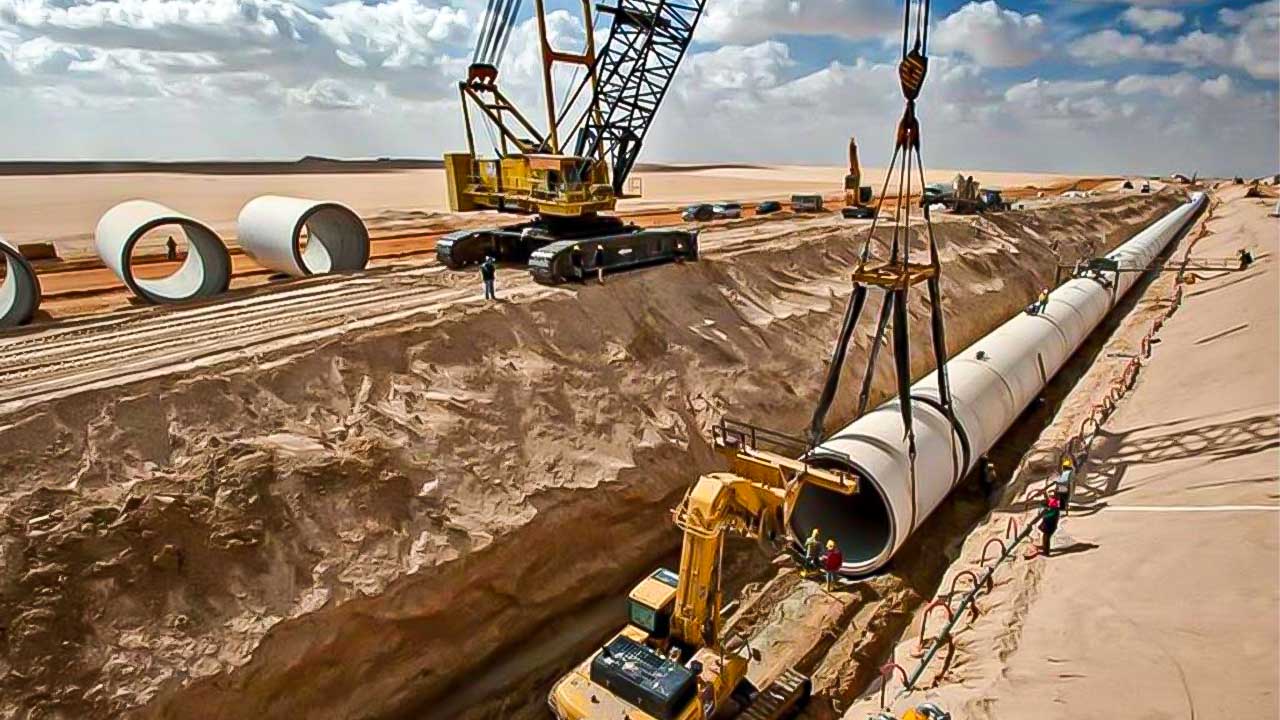
Libya’s project is a case in point. With 93 percent of its territory covered by desert and renewable resources below 200 cubic meters per person annually, the country faced collapsing aquifers along its coast. The Great Man Made River was conceived to tap into vast fossil groundwater reserves in the southern Kufra Sarir and Murzuk Hamada basins. Designed in five stages, it involves constructing massive wellfields and pipelines capable of transferring more than two billion cubic meters of water annually to the northern coastal regions. Stages completed in the 1990s began supplying Benghazi, Sirte, and the Jefara plain, stabilizing growth and easing shortages.
The economics of the project underline both its promise and its limits. Early estimates suggested transferred water could cost as little as $0.25 per cubic meter, far cheaper than desalination, which can exceed $5. Later studies placed the figure closer to $0.55–0.83, reflecting foreign contracting costs and financing. Even at this higher price, the project remains competitive under Libyan conditions, where alternatives are scarce. Yet the aquifers feeding the system are largely non-renewable, meaning depletion is inevitable. The project’s long-term viability depends on using the current supply window to strengthen the national economy and develop alternative sources, particularly desalination and conservation technologies.
To sum up, the Libyan Man Made River demonstrates that large-scale water transfers can provide a critical bridge under conditions of acute scarcity. While not a permanent solution, it buys time for economies to diversify and for new water technologies to mature. Looking ahead, the concept of Man Made Rivers may expand beyond national borders, forming regional or even global networks to redistribute water much like energy grids today. In an era of mounting water stress, such visionary projects, though costly and complex, may prove indispensable for ensuring equity, economic stability, and environmental resilience.
Article adapted by Heba Emsseri from:
Alghariani, S.A., 1993. Managing water scarcity through man made rivers. In: Coping with Scarcity and Abundance: Proceedings of the International Conference. Tripoli: Alfateh University, pp.607–614.
Leave a Reply