

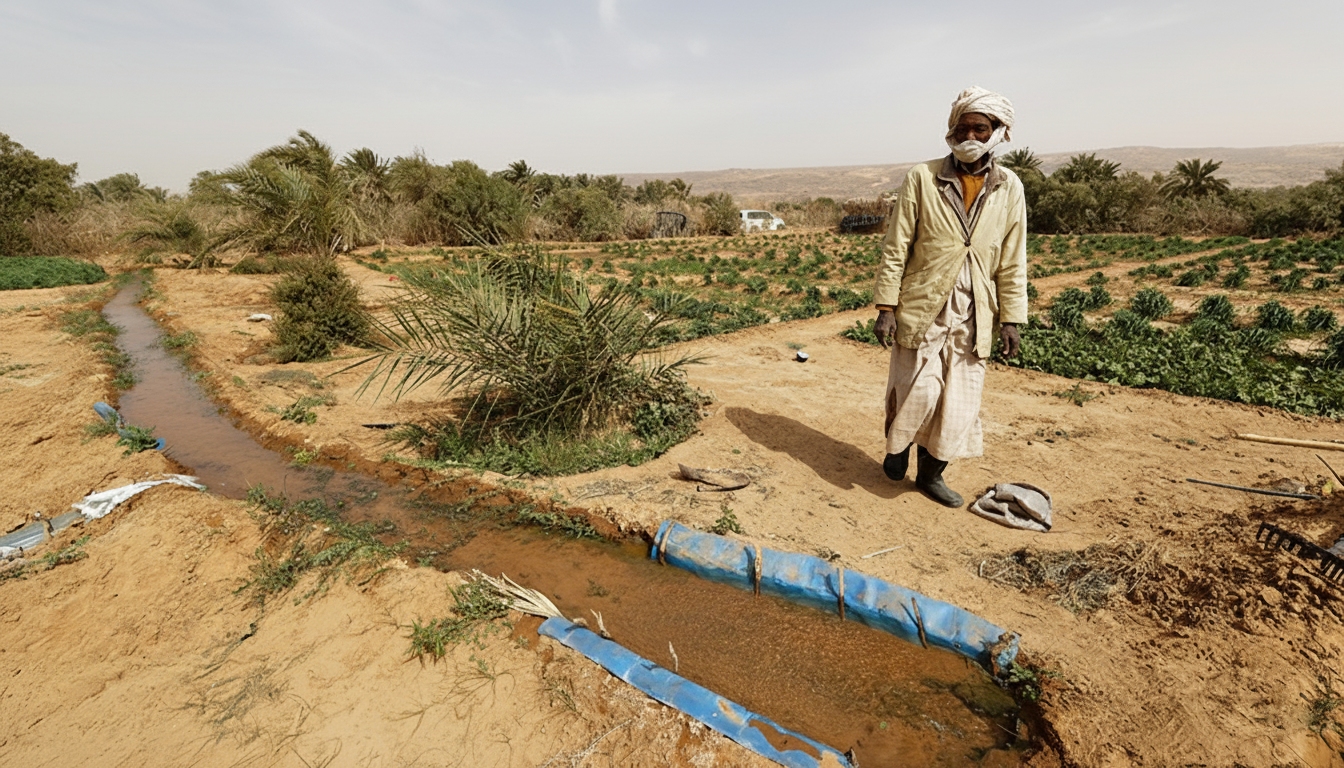
Managing Water Scarcity for Sustainable Irrigation in the Southern Mediterranean
Managing Water Scarcity for Sustainable Irrigation in the Southern Mediterranean Region
Water scarcity is tightening its grip on the Southern Mediterranean, where fragile natural resources are being stretched far beyond their limits. According to Saad A. Alghariani (1998), the region’s growing population, rapid urbanization, and reliance on irrigated agriculture have created a crisis that threatens both food security and economic stability.
The numbers tell a stark story. In 1955, per capita water availability in North Africa averaged more than 2,200 cubic meters per year. By 1990, that figure had fallen below 1,000, and by 2025 it is expected to reach just over 600. Agriculture, which consumes nearly 80 percent of available supplies, has shifted from traditional rainfed practices to large-scale irrigation, driving groundwater overdraft, seawater intrusion, and soil salinization .
The concept of water basins as management units highlights the scale of the challenge. Once all renewable inputs are consumed and no usable water leaves the basin, it becomes what hydrologists call a closed system. Many basins in the region have already reached this stage, where salts and pollutants accumulate, making irrigation increasingly unsustainable. The Jefara plain in northwestern Libya is a striking example, where a surplus in the 1950s has turned into a deficit of more than 750 million cubic meters annually.
Libya’s response has been bold. Faced with collapsing aquifers and deteriorating soil quality, the country launched the Great Man-Made River Project, one of the largest water transfer schemes in the world. Drawing on vast fossil groundwater reserves in the southern Kufra Sarir and Murzuk Hamada basins, the project has built pipelines capable of moving more than two billion cubic meters of water each year to the coastal plains. While this has eased immediate shortages, its long-term sustainability is uncertain without complementary measures such as desalination, conservation, and improved agricultural practices .
To sum up, the Southern Mediterranean stands at a crossroads. Water scarcity, driven by demographic pressures and unsustainable practices, threatens to undermine the region’s agricultural base and broader development goals. Large scale projects like Libya’s Great Man-Made River provide temporary relief, but lasting sustainability will depend on integrated basin management, improved efficiency, and bold economic reforms. Without decisive action, the region risks an escalating cycle of environmental degradation and socioeconomic instability.
Article adapted by Heba Emsseri from:
Alghariani, S.A. (1998) ‘Managing water scarcity for sustainable irrigation in the Southern Mediterranean region’, MEDIT, 9(2), pp. 47–52. Available at: https://www.iamm.ciheam.org/ress_doc/opac_css/index.php?lvl=author_see&id=6402&nbr_lignes=1.
Leave a Reply